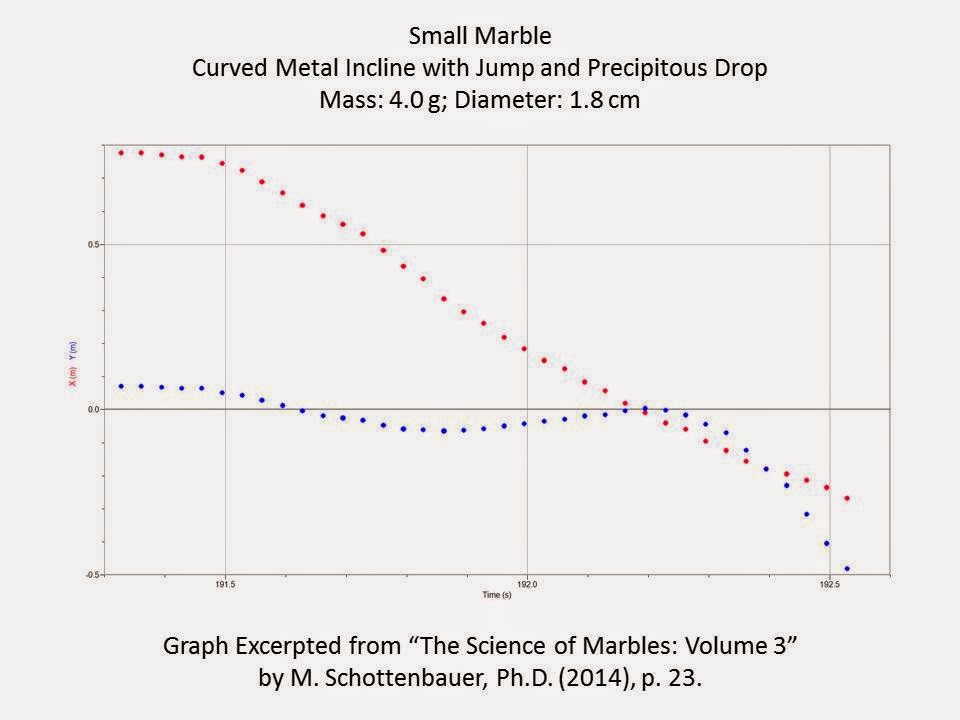
Toys present a wonderful mechanism for teaching physical science and physics, with virtually limitless lesson plans. Consider the following two graphs from Schottenbauer Publishing. These graphs can be used for lessons regarding dimension and friction.


Lesson 1: Dimension
Harmonic oscillation refers to a particular pattern of back-and-forth motion. The first graph above shows harmonic oscillation of a slinky held in the vertical direction. Notice that the slinky only demonstrates harmonic oscillation in one dimension.
Discussion Questions
- Beginning at the first peak, count the number of harmonic oscillations. The end of one oscillation is defined as the next peak.
- Beginning at the same point, measure the maximum and minimum points of each oscillation.
- Make a table, listing the minimum and maximum points of each oscillation.
- On the graph, draw a vertical line to delineate each beginning and ending of the oscillation.
- Measure the horizontal distance between peaks. List these in the table, using a third column. Do these values, formally called the "period," change over time? If so, how much?
- On the graph, draw a line connecting each maximum. Draw a line connecting each minimum.
- Over the course of the graph, how much does the maximum change? How much does the minimum change? Do the maximum and minimum change the same amount?
- Does the second graph show harmonic oscillation? If so, in how many dimensions doe the oscillation occur?
- What type of motion(s) consist of two-dimensional harmonic oscillation?
Lesson 2: Friction
Like any type of motion, harmonic oscillation may become slower due to friction. The lower graph shows a marble in circular motion on the rim of a drum pad. The drum pad provides friction, which slows the motion of the marble.
Discussion Questions
- For each colored line, count the number of harmonic oscillations. Begin at the first trough. The end of one oscillation is defined as the next trough.
- Beginning at the first trough, measure the maximum and minimum points of each oscillation.
- Make a table, listing the minimum and maximum points of each oscillation for each colored line.
- On the graph, draw a line connecting each maximum. Draw a line connecting each minimum.
- Over the course of the graph, how much does the maximum change? How much does the minimum change? Do the maximum and minimum change the same amount?
- For each dotted line, draw a vertical line to delineate each beginning and ending of each oscillation.
- Measure the horizontal distance between peaks. List these in the table, using a third column. Do these values, formally called the "period," change over time? If so, how much?
- Draw the motion of the marble on the drum pad, showing a minimum of 10 points in time.
- Does the graph show the marble coming to rest? Why or why not?
- Reviewing the data from Lesson 1, does the first graph show the effects of friction? Why or why not?
Graph books by M. Schottenbauer, Ph.D. are available in both English and German from Amazon, Barnes & Noble, Books-a-Million, Powell's, and other internet retailers. Wholesale is available directly from CreateSpace online.
Additional Information